
Goat supplies come down to one decision most new owners make backwards. You buy the fence and the feeders first, and you buy them for two goats, never for one.
I keep dogs, cats, rescue rabbits and a desert tortoise. I do not keep goats. So this page is a research day and a mechanic’s eye on hardware, not a pasture diary, built the way I used to spec truck parts in the Henderson shop. I read what the maker actually claims, then I check it against what extension services publish.
This is the goat supplies hub on Pet Approves. Herd size comes first, then fencing, shelter, hay, minerals, hooves, water and the kit you keep on a shelf. Each section hands off to a deeper guide.
Best Hay Feeder for Goats 2026: My 10 Picks After a Research Day
I do not keep goats, so this is a full research day plus what owners report. Ten hay feeders, from no waste racks with catch trays to wall mounted racks and hanging bags, ranked on capacity, steel, mounting and what the makers will actually state.
Read the guide →Best Goat Hoof Trimmers 2026: My 10 Picks After a Research Day
I do not keep goats, so this is a full research day on 10 goat hoof trimmers, kits and electric grinders. Blade steel, springs, pivots and what the makers actually state.
Read the guide →Best Goat Mineral Feeder 2026: My 10 Picks After a Research Day
I do not keep goats, so I spent a full day on every mineral feeder and block holder worth buying now, reading the listings and what goat owners report. Ten picks, wall mount and hanging, a feature check table, and the mounting hardware nobody warns you about.
Read the guide →Best Electric Fence for Goats 2026: My 11 Picks After a Research Day
I do not keep goats, so this is a research day and what owners report. Eleven portable electric nets and kits compared on stated joules, post spacing, height and what actually breaks.
Read the guide →Jump to:
- Goat supplies start with two goats, never one
- Fencing, the tallest thing you buy
- Shelter, bedding and one dry corner
- Hay and the feeder that stops the waste
- Minerals, offered free choice
- Hooves grow on a schedule
- Water buckets, in heat and in freeze
- The kit you keep on the shelf
- Goat supplies buy first, in order
- Goat supplies questions, answered
Goat supplies start with two goats, never one
Every goat supplies list you will read assumes a number, and the number is at least two. Goats are herd animals and a single goat is a stressed goat. Breed associations and extension services both open with that line before they get anywhere near equipment.
That doubles half your list before you have bought anything. Two goats means two feeding spots, a shelter wide enough that a bullied goat can move away, and a pen sized for a pair rather than a pet.
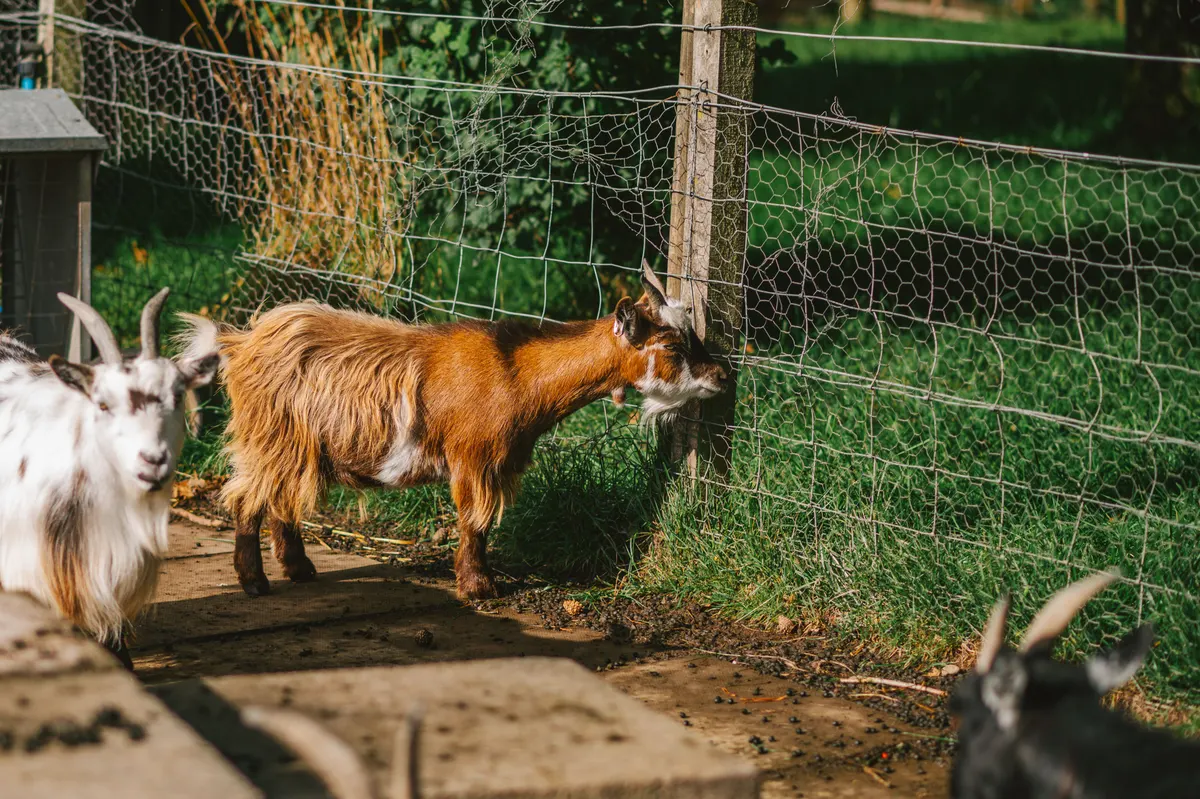
For a backyard, the small breeds are the ones people keep. Nigerian Dwarfs and Pygmies stand somewhere around knee height on an adult. They are small, and small is exactly why owners underbuy the fence. A goat that only reaches your knee still climbs, still leans, and still gets its head through a gap you were sure was too narrow.
Wethers, meaning castrated males, are the usual pet choice. They stay friendly, they do not come into season, and they do not carry the buck smell that ends a suburban goat project fast. The American Dairy Goat Association is the place to read breed standards before you commit to a size.
Two goats also change the ground. Goats are browsers, not grazers, so they go after brush, saplings and anything leafy at head height before they touch the lawn. Whatever is planted inside the fence line is on the menu, and extension services publish lists of plants that are toxic to goats. Check your yard against one of those lists before the goats arrive, not after.
| What you keep | What that changes in your goat supplies | Guide |
|---|---|---|
| Two Nigerian Dwarfs | Small pen, but full height fence | Electric fence |
| A herd that climbs | Netting or taller woven wire | Electric fence |
| Horned goats | Smaller mesh openings, fewer head traps | Electric fence |
| Winter herd | Hay volume, and a feeder that holds it | Hay feeder |
| Any herd, all year | Loose mineral, kept dry, always out | Mineral feeder |
| Soft ground, little rock | A trimming schedule you actually keep | Hoof trimmers |
Fencing, the tallest thing you buy
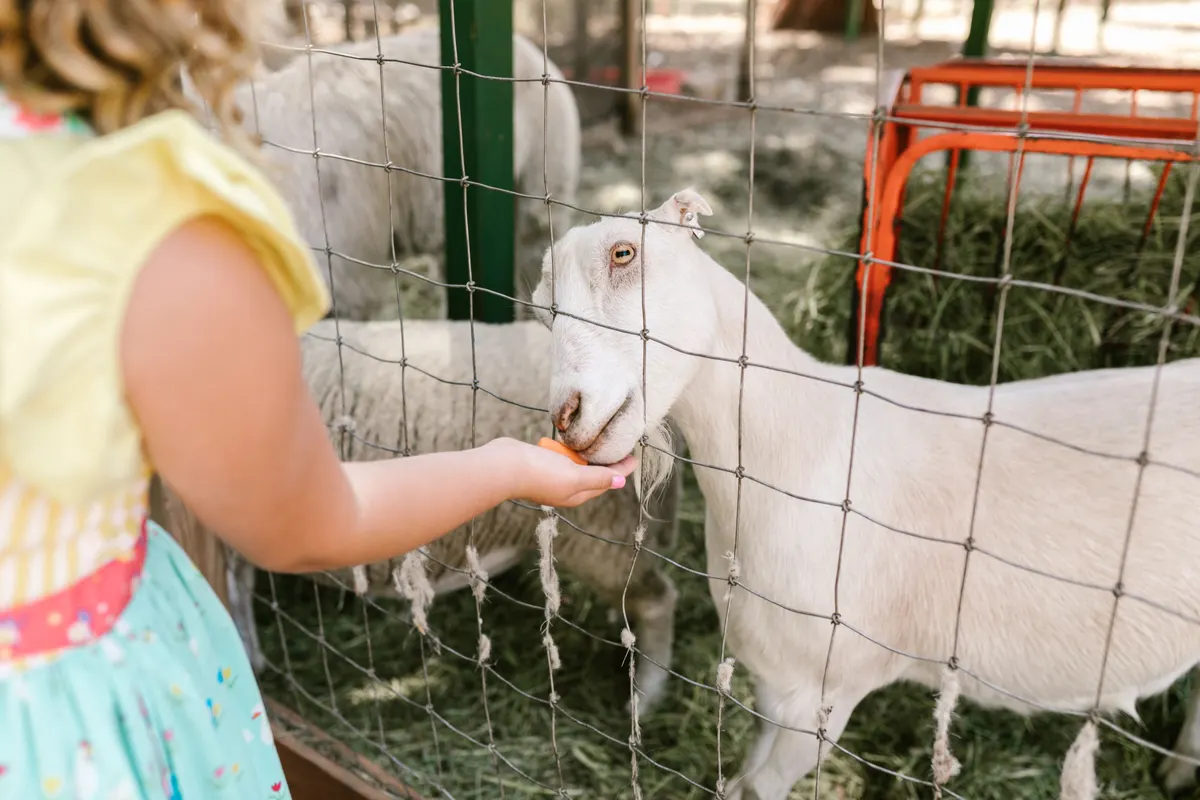
The fence is the one item in a goat supplies list that fails loudly. A bed that disappoints you is a bad afternoon. A fence that disappoints you is your neighbor’s rose bed at seven in the morning.
Height is the number everyone asks about first, and it is the wrong place to start a goat supplies build. Goats rarely jump a fence cleanly. They climb it, they lean into it until it bows, and they walk along the top of anything that gives them a foothold. So the question is not only how tall, it is what a hoof can grip.
Two builds dominate. Woven wire field fencing on posts is the permanent answer, and the opening size matters more than the wire gauge. Wide rectangular openings are the classic head trap for a horned goat, which is why smaller openings get recommended for horned herds. Electric netting is the movable answer, quick to reposition when you want the goats clearing brush in a new spot.
Read the charger spec the way you would read a torque figure. Makers publish joules, and joules are what the maker states about the energizer, not a promise about your soil, your grounding rods or your weeds. A netting line shorted by wet grass is a fence in name only.
Gates and corners are where builds go soft. A goat leans on a gate hinge every day of its life, so the gate needs to be the strongest part of the run, not the cheapest. Penn State Extension’s goat pages are a good sanity check on layout before you set posts.
The electric fence for goats guide ranks eleven options and goes deeper on kits, portable netting, tall netting for climbers, solar chargers and how many strands owners actually run.
Shelter, bedding and one dry corner
The shelter half of a goat supplies list is short but unforgiving. Goats handle cold far better than they handle wet. A soaked goat in a draft is the problem, not a cold goat in a dry one. That single fact sets the build.
The common build is a three sided shelter with the open side turned away from the prevailing wind. It needs a roof that sheds, a floor that stays dry, and enough width that two goats can lie down apart from each other. Small breeds do not need much square footage, but they do need the option to separate.
Bedding is a rebuy, so plan the storage on day one. Straw and pine shavings are the two usual answers. Whichever you pick, you will be buying it again, and a bale left in the rain is a bale you throw out. A dry, rodent resistant place to keep bedding and feed is part of the setup even though nobody lists it.
Ventilation gets underrated because it is invisible. A sealed shelter traps moisture and ammonia from bedding, and owners consistently report that a shelter with an open face and a gap under the eaves stays drier than a closed box. Airflow above head height, no draft at floor height, is the shape to aim for.
Height inside matters more than you would guess, because goats climb onto anything. A shelf, a stump or a low platform inside the pen gives them somewhere to perch and keeps them off the shelter roof. Build it before they teach themselves that the roof works.
Put the shelter where you walk past it. The same rule holds for every animal I have kept in the desert. A shelter at the back fence gets checked half as often as one near the gate, and checking is what catches problems early.
Hay and the feeder that stops the waste
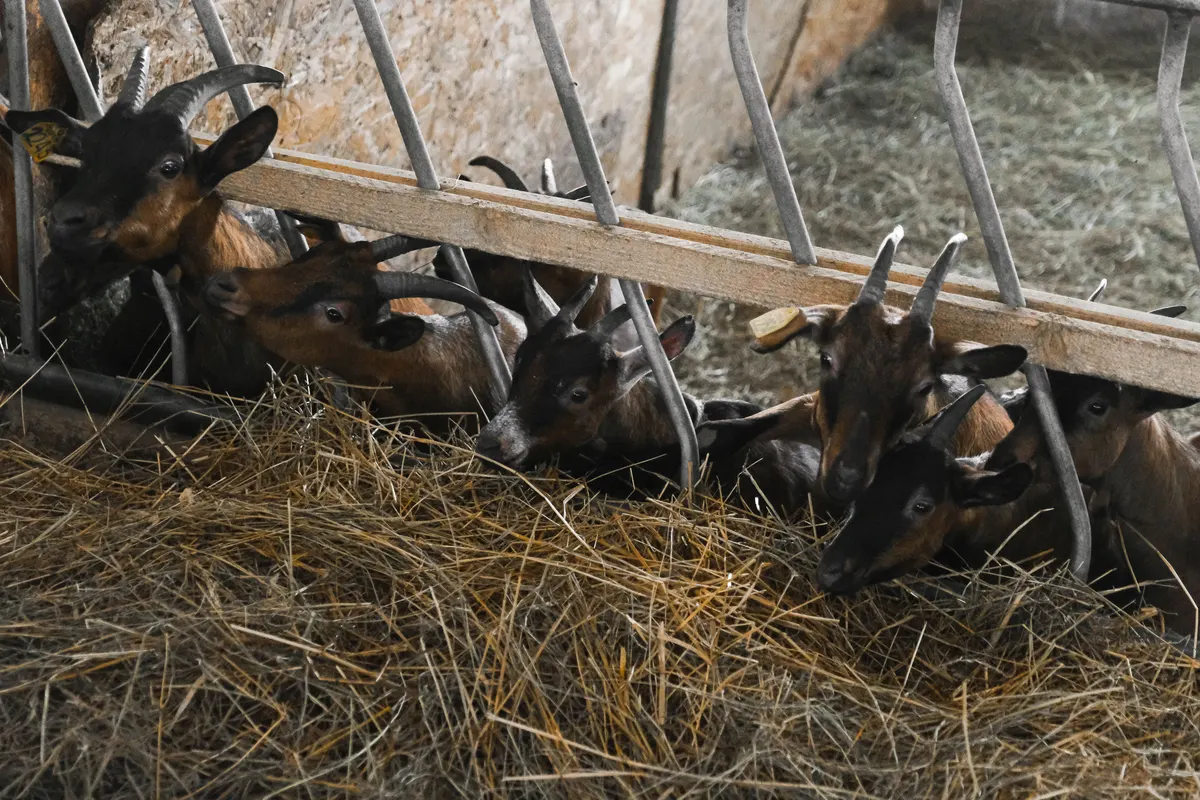
Hay is the largest running cost in any goat supplies budget, and goats are famously wasteful with it. They pull, they sort, they drop, and they will not eat hay they have stood on. A feeder is not a nicety, it is the thing that decides how much of each bale actually gets eaten.
The mechanism that matters in this part of your goat supplies is the catch tray. A rack with a solid tray underneath catches the dropped stems and gives the goats a second run at them. A rack without one feeds the bedding pile.
Opening size does the rest of the work. Narrow slots or small grid openings slow a goat down and stop it dragging a mouthful sideways out of the rack. Wide bars let a goat pull out more than it can chew. Horned goats need the same care here as at the fence, because a rack opening is another place to get a head stuck.
Mounting height is the third variable. Set the rack so a standing goat eats at chest to head height, which keeps hay and seed out of their coats and out of their eyes. For a mixed size herd, that means picking the height for the shortest goat and accepting that the tallest one has to lower its head.
Browse is the other half of the diet story. Goats are browsers, so they prefer brush and leaves to lawn, and a bare paddock means you are supplying all of the forage yourself. Owners who rotate their goats across brushy ground buy noticeably less hay in the growing season.
The hay feeder for goats guide works through no waste designs, catch trays, wall mounted racks, combination hay and grain feeders and what holds up outdoors.
Minerals, offered free choice
This is the one section of a goat supplies list where the wrong product is worse than no product. Goat mineral and sheep mineral are not interchangeable, because sheep formulations are deliberately built without added copper. Extension services are direct about it: buy a mineral labeled for goats.
The standard approach is loose mineral offered free choice, meaning available all the time so the goats take what they take. Michigan State University Extension’s write up on goat mineral nutrition is the clearest free read on why loose beats a block for most herds. I am not going to publish a dose here, and neither should any gear page. Your feed store and your vet know your region’s soil, and that is the variable.
Which makes the feeder a moisture problem, not a nutrition problem. Loose mineral turns to a brick the moment it gets wet. A feeder that keeps rain off, sheds splash from a hose, and lets you see the level from outside the pen is doing the whole job.
Mounting decides whether it stays clean. Fixed to a wall, a fence line or a pen panel at goat head height, the mineral stays out of the mud and out of reach of a goat that would otherwise stand in it. Loose on the ground, it is contaminated within a day.
Size it for the herd and for how often you want to top it up. A two goat setup needs a small feeder refilled often, which keeps the mineral fresh, and a larger herd needs enough openings that a low ranking goat is not blocked out.
Weather kills these things slowly. Sun cracks thin plastic, which was the failure I watched over and over in Henderson with every kind of pet gear. Look for thicker walls, ultraviolet stabilized plastic where the maker states it, or metal.
The goat mineral feeder guide ranks eleven, covering wall mount designs, loose mineral against block holders, hanging and fence line options, bigger herd capacity and how each one handles rain.
Hooves grow on a schedule

Hoof care is the goat supplies job you do with your hands rather than your wallet. Goat hooves keep growing whether or not the ground wears them down. On soft pasture they overgrow, fold under and trap muck. On rocky ground they wear naturally and need far less help. Your terrain sets your interval, which is why nobody can give you one number that fits every herd.
Trimming is a routine job, done standing, with the goat held or on a stand. Most owners work on a cycle of a few weeks to a couple of months and adjust by looking at the foot rather than the calendar. Extension services and breed groups publish the technique with photographs, and photographs are what you want the first time.
The goat supplies answer here is a shear, not a knife. Goat hoof trimmers look like heavy duty pruning shears with a curved or straight blade, and the difference between a good pair and a bad pair is the spring and the steel. A blade that dulls in a season turns a ten minute job into a fight.
Handles matter as much as blades. If you are trimming eight feet across two goats, grip comfort and the return spring decide whether you finish the herd in one go. This is a hand tool, and hand tools get judged the way I judged shop tools, by how they feel on the twentieth cut rather than the first.
A stand or a second person is the unlisted item. A goat that is properly restrained holds still, and a goat that is wrestled learns to hate the whole business. Owners who bought a stand say the same thing about it that rabbit owners say about a bigger hutch, they wish they had bought it first.
The goat hoof trimmers guide ranks eleven, covering hand shears, farrier kits in a box, electric trimming systems, blade steel and springs, and how the makers describe the trimming process.
Water buckets, in heat and in freeze
Water is the cheapest line on a goat supplies list and the one that causes the most trouble. Goats are fussy about dirty water and drink less when the bucket is fouled. Less water intake is the start of a lot of problems, so the bucket is worth more attention than its price suggests.
Buckets beat open troughs for a small herd. They are easier to dump, scrub and refill daily, and daily is the frequency that actually works. A trough is less work per fill and more work per clean, and the clean is the part people skip.
Mounting is the whole trick. A bucket hung on a fence bracket at chest height stays cleaner than one on the ground, because a goat that can stand in it will stand in it. Hung buckets also stop the daily knock over that empties the water an hour after you filled it.
Heat and freeze pull the design in opposite directions. In summer, shade over the bucket and a second bucket in a different spot keep water drinkable through the afternoon, which is the lesson the desert taught me with every animal. In winter, owners in cold states run heated buckets or bucket heaters, and the safety question there is the cord, not the water. Route it out of reach, because a goat will chew anything at head height.
Two water points is the quiet goat supplies upgrade for a herd of any size. It removes the bottleneck when one goat guards the bucket, and it gives you a spare when one gets fouled.
The kit you keep on the shelf
The last of the goat supplies is the small stuff, and it is the part that gets bought in a panic if you skip it. Keep it in one box, near the pen, not scattered across a garage.
A halter and a lead come first in this part of the goat supplies list. You need to be able to move a goat that does not want to move, for a vet visit, a hoof trim or a loading. A halter that fits a small breed is not the same halter that fits a full sized goat, so size it to the animal you actually have.
Grooming is light work for short coated pet goats. The goat supplies here are a stiff brush, a comb for the ones with longer coats, and a look at the skin while you brush. Oregon State University Extension’s sheep and goat pages cover the routine husbandry side well.
Then the record keeping. A weight tape, a notebook or a phone note, and dates. Trim dates, mineral refills, when the hay came in. That log is what turns guessing into a schedule, and it costs nothing.
The item that is not a product: a vet who sees goats. Small ruminants are not every practice’s work, so find one before you need one. I will not print health advice on a gear page, and this is the reason. The right answer to a sick goat is a phone number, not a purchase.
Fly control, a first aid box and a set of gloves round it out. Extension services publish what belongs in a goat first aid kit for your region, and that list beats anything a gear site can tell you.
Goat supplies buy first, in order
New owners tend to buy the fun goat supplies first and the fence last. Run it the other way. This is the goat supplies order I would buy in if a pair of goats were coming home this week.
- The fence. Woven wire or electric netting, built for climbing rather than jumping, with the gate as the strongest part.
- The shelter. Three sided, dry floor, open face out of the wind, wide enough that two goats can lie apart.
- Hay and a feeder with a catch tray. Sized for the herd, mounted at head height, storage sorted before the first bale arrives.
- A goat labeled loose mineral and a covered feeder. Free choice, kept dry, mounted where it cannot be stood in.
- Water buckets. Two of them, hung on brackets, plus a heated option if your winters freeze.
- Hoof trimmers. One good pair, plus a stand or a second person, before the first foot needs doing.
- Halter, lead and gloves. The handling kit, sized to a small breed.
- Bedding, storage and a logbook. The rebuy items, plus the dry place to keep them.
Note: the fence is the item in a goat supplies list people redo. Almost nobody writes in to say their fence turned out too tall or too tight. Build it for a climber now and you skip the second build.
Goat supplies questions, answered
What goat supplies do you need to start?
The starter goat supplies list is short. A fence built for climbers, a three sided shelter, hay with a feeder that catches waste, a goat labeled loose mineral in a covered feeder, hung water buckets, hoof trimmers, and a halter and lead. Everything else can wait a week.
How many goats should you keep?
At least two, and that number sets the size of every goat supplies purchase. Goats are herd animals and breed associations and extension services both lead with that before they mention any equipment. A single goat is a stressed goat, and a stressed goat is a noisy escape artist.
How tall does a goat fence need to be?
Taller than most goat supplies lists suggest, and tall enough that a climbing goat cannot walk up it, which is a different question from how high a goat can jump. Look at footholds and opening size as well as height, and treat horned goats as a separate case because wide openings trap heads.
What minerals do goats need?
A mineral labeled for goats, offered loose and free choice. Sheep mineral is formulated without added copper and is not a substitute. Extension services publish the regional detail, and your vet knows your soil, so ask there rather than taking a number off a gear page.
How often do goats need their hooves trimmed?
It depends entirely on your ground, which is why no goat supplies guide can hand you one interval. Rocky, hard terrain wears hooves down and stretches the interval. Soft pasture does almost nothing and shortens it. Owners judge by looking at the foot, not by a fixed date.
Do pet goats need a barn?
No, and this is where goat supplies lists overspend. A three sided shelter is the common build for a small backyard herd. What they need is dry, draft free space out of the wind and rain, with airflow above head height. Goats cope with cold far better than they cope with wet.
Can goats live in a backyard?
Yes in many places, and the goat supplies list does not change. Small breeds like Nigerian Dwarfs and Pygmies are the ones people keep in suburban yards, usually as wethers. Check your local rules first, then check the fence, then check what is planted inside it, because goats browse brush and saplings before they touch grass.
 Gunner Vance